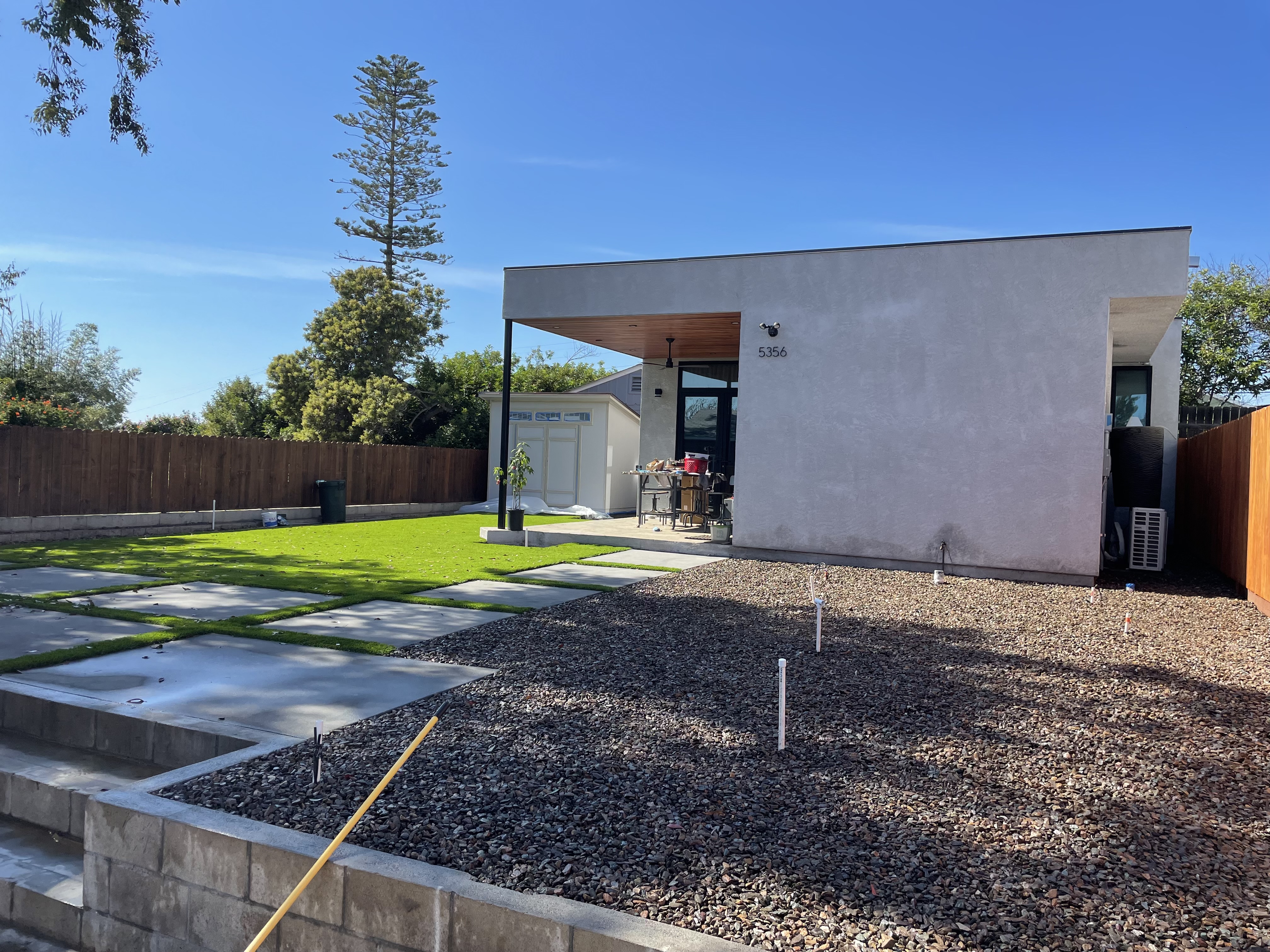
If you are considering an accessory dwelling unit (ADU) on your property, the first question is almost always about money: how much does an ADU cost in San Diego? The short answer is that most San Diego ADUs cost between roughly $150,000 and $450,000 to design, permit, and build. A small garage conversion can come in lower, and a large, high end detached unit can go higher. Where your project lands depends mostly on the type of ADU, its size, your lot, and the finishes you choose.
This guide breaks down real San Diego ADU costs by type, explains what drives the price up or down, walks through the costs people tend to forget, and shows how to get an accurate number for your specific property. It comes from Arrow Construction, a licensed San Diego general contractor (CA LIC #1040491) that handles ADU design, permitting, and construction under one roof.
Quick answer: San Diego ADU cost by type
Here is a fast reference before we get into the details. These are typical all in ranges for design, permits, and construction in the San Diego area:
- Junior ADU (JADU): roughly $80,000 to $150,000
- Garage conversion: roughly $100,000 to $180,000
- Attached ADU: roughly $150,000 to $300,000
- Detached ADU: roughly $250,000 to $450,000 or more
For new detached construction, it also helps to think in terms of cost per square foot. In San Diego, custom ADU construction commonly runs about $300 to $500 per square foot, depending on finishes, site conditions, and design complexity.
Keep in mind these are estimates meant to help you plan. The only way to get a firm number is to have someone review your actual lot and goals, which we cover at the end of this guide.
Already have approved plans?
Skip the ranges. Upload your approved ADU plan set to our Instant ADU Estimate and get an itemized, San Diego priced estimate in minutes.
Get my instant ADU estimateWhat is an ADU, and why the cost varies so much
An ADU is a second, self contained living space on a residential lot. It has its own kitchen, bathroom, and living area, and its own entrance. San Diego homeowners build them for rental income, for aging parents or adult children, for a home office or studio, or simply to add long term value to the property.
Because "ADU" covers everything from a converted garage to a brand new detached home in the backyard, the cost range is wide. A conversion reuses structure that is already there. A detached build starts from bare ground and needs its own foundation, framing, roof, and utility connections. That single distinction is the biggest driver of price, so it is worth understanding each type.
ADU cost by type, explained
Junior ADU (JADU)
A JADU is a compact unit created within the walls of your existing home, often from a spare bedroom, with its own entrance and a small kitchen. Because you are working inside the existing footprint, a JADU is usually the least expensive option, commonly $80,000 to $150,000. It is a strong choice when the goal is added flexibility or modest rental income without a major build.
Garage conversion
Converting an existing garage is one of the most popular and affordable ways to add an ADU in San Diego, typically $100,000 to $180,000. The foundation, walls, and roof already exist, so much of your budget goes toward insulation, drywall, a kitchen, a bathroom, flooring, and bringing electrical and plumbing up to code for a living space. Costs climb if the garage needs a new subpanel, significant plumbing, or upgraded insulation and windows.
Attached ADU
An attached ADU shares at least one wall with your main house, built as an addition. Expect roughly $150,000 to $300,000. You may save on some site work and one shared wall, but you take on new framing, roofing, and a complete set of finishes. Attached units work well on lots where a fully detached structure would be tight.
Detached ADU
A detached ADU is a standalone unit, usually in the backyard, and it is the most flexible and private option. It is also the most involved, commonly $250,000 to $450,000 or more, because it needs its own foundation, framing, roof, siding or stucco, and separate utility connections. If you want a true second home on the property, whether for rental income or family, this is the type most homeowners picture.
Site built versus prefab
Most of the ranges above assume a site built ADU, constructed on your property like a custom home. Prefabricated or manufactured units, built in a factory and delivered, can sometimes lower the construction cost, but you still pay for the foundation, utility connections, delivery, crane placement, permits, and site work. Prefab is worth exploring, but the sticker price of the unit alone is rarely the full cost.
What drives the cost of a San Diego ADU
Two similar looking projects can quote very differently. These are the factors that move the number the most:
- Size. The single clearest driver. More square footage means more framing, roofing, flooring, cabinetry, and finishes. A 400 square foot studio and a 1,000 square foot two bedroom are very different projects.
- Site conditions. A flat, open, accessible lot is cheaper to build on than a sloped or tight one. Grading, retaining walls, difficult access for equipment, and hand digging all add cost.
- Soil and foundation. Expansive or unstable soil can require a more engineered foundation, which raises the price before a single wall goes up.
- Utilities. Running new water, sewer, gas, and electrical service to a detached unit adds cost. If your existing electrical panel cannot support a second dwelling, a panel upgrade is often needed.
- Finishes. Standard cabinets, counters, flooring, and fixtures cost far less than high end selections. This is the lever you control most directly.
- Design complexity. A simple rectangular unit is more affordable than one with lots of corners, custom rooflines, or large expanses of glass.
- Permits and fees. These vary by jurisdiction within San Diego County and by project. We account for the current requirements in your quote so there are no surprises.
The costs people forget to budget for
When homeowners compare quotes, they often focus only on the building itself and get surprised later. A realistic budget should account for:
- Electrical panel upgrades to support a second unit
- Utility trenching and connections for water, sewer, and gas
- Impact and permit fees required by the local jurisdiction
- Site work such as grading, drainage, and access
- Hardscape and landscape like a pathway, small patio, or fence for privacy
- Design and engineering for plans, structural details, and Title 24 energy compliance
- A contingency of around 10 to 15 percent for the unexpected, which is normal on any construction project
A quote that ignores these items is not cheaper, it is just incomplete. One of the advantages of working with a single team is that your estimate reflects the whole project from day one.
A sample budget for a detached ADU
To make this concrete, here is an illustrative breakdown for a mid range detached ADU in San Diego. Your actual numbers will differ, but this shows where the money tends to go:
- Design, engineering, and permitting: 10 to 15 percent of the project
- Site work, foundation, and utilities: 20 to 25 percent
- Framing, roofing, and exterior (stucco, windows, doors): 25 to 30 percent
- Electrical, plumbing, and mechanical: 15 to 20 percent
- Interior finishes (kitchen, bath, flooring, paint): 20 to 25 percent
Seeing the project this way helps explain why finishes and site conditions have such a large effect on the final price.
Ways to keep your ADU cost down
You do not have to pick the cheapest option to build smart. Reliable ways to protect your budget:
- Start with a garage conversion or a smaller footprint if the main goal is rental income.
- Keep new plumbing close to existing lines to reduce trenching.
- Choose durable, mid range finishes that look great and rent well without premium pricing.
- Favor a simple, efficient floor plan over a complex one.
- Work with one team for design, permitting, and construction, so nothing gets lost in the handoffs between a separate architect, permit expediter, and builder.
Financing an ADU in San Diego
Many homeowners finance an ADU with a home equity line of credit, a renovation loan, a cash out refinance, or a construction loan. The reason so many people move forward is that an ADU is one of the few home improvements that can pay you back. In a rental market as strong as San Diego, a well built unit can generate meaningful monthly income and add lasting value to your property. It is worth speaking with a lender early so you know your budget before design begins.
How long does an ADU take to build?
Cost and time go together. Design and permitting typically take several months, followed by construction. Most San Diego ADUs take roughly 8 to 14 months from the first feasibility review through the final walkthrough, depending on scope, site conditions, and how quickly approvals move. Building the design and permitting into one process with your contractor usually keeps the timeline tighter and more predictable.
Why one team matters for your budget
When you hire an architect, a permit expediter, and a contractor separately, the estimate you start with and the price you end with often drift apart. Details fall through the cracks between companies, and each handoff is a chance for cost to creep. At Arrow, design, engineering coordination, permitting, and construction are handled by one team, so your quote reflects the real project and you always know who is accountable. That predictability is worth as much as the sticker price.
Frequently asked questions
Already have approved plans? Get an instant ADU estimate
If your ADU plans are already drawn and approved, you do not have to wait for a callback to see numbers. Arrow Construction's Instant ADU Estimate reads your uploaded plan set and returns an itemized cost estimate priced for the San Diego market, broken down by trade, in minutes. It also reviews your drawings and flags anything missing, conflicting, or incomplete before you build.
Upload your PDF, get your San Diego ADU estimate on the spot, and Felix follows up with a firm written proposal. It is free and there is no obligation. Try the Instant ADU Estimate
Get a real number for your property
Every lot is different, so the best way to know what your ADU will cost is to have someone review your specific property and goals. Arrow Construction offers a free ADU feasibility check: we look at your lot, talk through your best options, and give you a clear, fixed quote with no obligation. Most homeowners hear back within 24 hours. And if you already have approved plans, you can skip the wait and get an instant, itemized estimate now.
Call 619.402.2190 or request your free ADU feasibility check to get started.